The New Silk Roads: Infrastructure Diplomacy Across Three Continents
From ports in Sri Lanka to railways in East Africa, infrastructure projects funded by global powers are redrawing the map of economic influence.

On the southern coast of Sri Lanka, the Hambantota International Port sits largely empty. Built with $1.4 billion in Chinese loans, the deep-water facility was meant to become a critical node in Indian Ocean shipping. Instead, it became a cautionary tale. Unable to service its debts, Sri Lanka leased the port to a Chinese state-owned company for 99 years in 2017, a transaction that critics around the world seized upon as proof of what they called "debt-trap diplomacy."
Whether Hambantota represents exploitation or simply a bad investment depends on whom one asks. But the port's story illuminates a much larger phenomenon: across three continents, infrastructure projects funded by global powers are redrawing the map of economic influence, and the nations caught in the middle are learning to navigate between competing offers with increasing sophistication.
The Belt and Road's Expanding Footprint
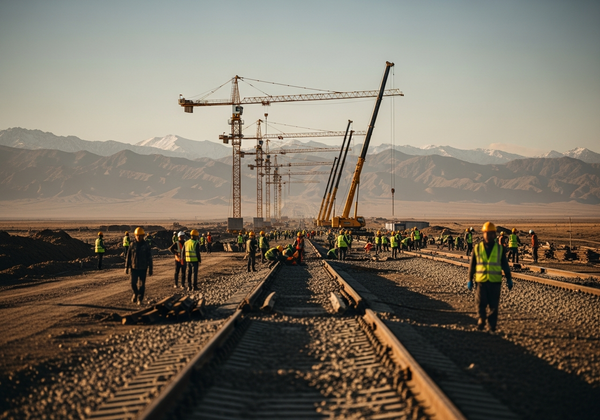
China's Belt and Road Initiative, launched in 2013, remains the largest infrastructure investment program in modern history. By 2025, Beijing had committed an estimated $1.3 trillion across more than 140 countries, funding everything from railways in East Africa to 5G networks in Southeast Asia. The initiative's scale dwarfs anything offered by Western governments, and its speed of execution, unburdened by the environmental and social impact assessments required by multilateral development banks, has made it attractive to leaders seeking visible results within electoral cycles.
The Addis Ababa-Djibouti Railway, completed in 2018, connected landlocked Ethiopia to the Red Sea coast in a project that took less than six years from groundbreaking to operation. Kenya's Standard Gauge Railway, linking Nairobi to the port of Mombasa, cut freight transit times from 24 hours to 8. In Pakistan, the China-Pakistan Economic Corridor has channeled more than $60 billion into highways, power plants, and special economic zones.
"Infrastructure is the new arena of great power competition. Whoever builds the roads, railways, and ports of the developing world will shape its economic orientation for a generation."
The Western Counter-Offer
The scale of China's investments eventually provoked a response. In 2021, the G7 launched Build Back Better World (B3W), later rebranded as the Partnership for Global Infrastructure and Investment, pledging $600 billion in financing by 2027. The European Union's Global Gateway program committed an additional 300 billion euros. Japan, through its Partnership for Quality Infrastructure, had already been quietly funding projects across South and Southeast Asia for years.
The Western alternatives emphasize transparency, environmental sustainability, and labor standards, distinctions that carry genuine weight in some contexts. But they also come with conditionalities that slow disbursement and limit flexibility. A World Bank-funded road project typically takes seven to ten years from conception to completion. A Chinese-funded equivalent may take three.
For recipient nations, this creates a genuine dilemma. Speed and scale on one hand, sustainability and governance standards on the other. Increasingly, the most strategically astute governments are choosing both, playing competing offers against each other to extract better terms.
Navigating Between Giants
Indonesia offers a case study in this approach. Jakarta has accepted Chinese funding for the Jakarta-Bandung High-Speed Railway while simultaneously partnering with Japan on the broader Trans-Java rail network. It has welcomed Chinese investment in nickel processing while negotiating separate technology transfer agreements with European firms. The strategy is deliberate: diversify funding sources, avoid dependence on any single creditor, and retain bargaining power.
Similar patterns are visible across Africa. Kenya, despite its heavy borrowing from China, has secured infrastructure funding from the United States, the EU, and Japan for port expansions and renewable energy projects. Senegal has balanced Chinese-funded highway construction with French-backed digital infrastructure. The narrative of passive developing nations victimized by predatory lending, while compelling, increasingly fails to capture the agency these governments exercise.
Debt, Dependency, and Development
The debt-trap debate remains unresolved, in part because the evidence is mixed. Research by institutions including the Johns Hopkins China-Africa Research Initiative has found little support for the claim that China systematically uses debt to seize strategic assets. Hambantota appears to be an outlier rather than a template. Most Chinese loan restructurings have involved maturity extensions or interest rate reductions, not asset seizures.
Yet the debt burdens are real. Several Belt and Road participant nations, including Zambia, Laos, and Pakistan, have faced severe debt distress, with Chinese loans comprising a significant share of their external obligations. The challenge is separating correlation from causation: many of these countries were already on precarious fiscal trajectories before Belt and Road lending began.
The Road Ahead
Infrastructure diplomacy is entering a new phase. China's lending has become more selective following a wave of non-performing loans. Western alternatives are slowly gaining traction, though they remain far smaller in scale. And recipient nations, having spent a decade learning the dynamics of great power competition, are becoming more adept at leveraging their strategic position.
The ultimate measure of these competing visions will not be the volume of concrete poured or the kilometers of rail laid. It will be whether the infrastructure built today generates genuine economic development, creates sustainable employment, and strengthens the nations it connects rather than merely binding them to distant creditors. On that question, the verdict is still decades away.
 Maria Fernandez
Written by
Read next

Arctic Ambitions: Why Northern Shipping Lanes Reshape Global Trade
Receding Arctic ice is opening shipping routes that were once impassable, triggering a quiet but intense competition among northern nations over trade, sovereignty, and environmental stewardship.
The Quiet Rise of African Tech Hubs
From Lagos to Nairobi to Cape Town, a generation of entrepreneurs is building a technology ecosystem that global investors and multinational firms can no longer afford to overlook.
Water Diplomacy: The Geopolitics of Shared Rivers
As climate change disrupts rainfall patterns and populations swell, the rivers that cross national borders are becoming some of the most contested spaces in international diplomacy.
The New Yorker's Political Stage: Podcasts and Local Power Plays
The New Yorker's "Political Scene" podcast and its reporting on the New York City Council speaker race illustrate the magazine's reach from national policy analysis to granular local politics.
The Architecture of Compromise: How Bills Actually Become Laws
The journey from policy idea to enacted law is far messier than any civics textbook suggests, built on committee gatekeeping, back-channel negotiations, and the deliberate architecture of compromise.
Arctic Ambitions: Why Northern Shipping Lanes Reshape Global Trade
Receding Arctic ice is opening shipping routes that were once impassable, triggering a quiet but intense competition among northern nations over trade, sovereignty, and environmental stewardship.