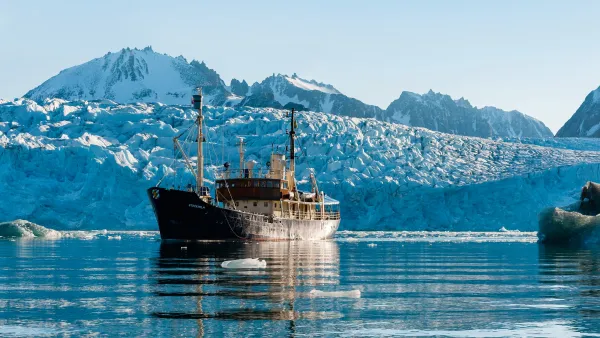
Arctic Ambitions: Why Northern Shipping Lanes Reshape Global Trade
Receding Arctic ice is opening shipping routes that were once impassable, triggering a quiet but intense competition among northern nations over trade, sovereignty, and environmental stewardship.

For most of recorded history, the Arctic Ocean has been an impenetrable barrier, a frozen expanse that divided continents and defied navigation. That barrier is dissolving. As polar ice retreats at a pace that continues to surprise even cautious climate scientists, waterways that were once locked for all but a few weeks each year are becoming viable shipping corridors. The implications extend far beyond logistics. The opening of the Arctic is reshaping the strategic calculus of nations, redrawing trade routes that have remained essentially unchanged for centuries, and raising urgent questions about environmental stewardship in one of the planet's most fragile ecosystems.
The Routes Taking Shape
Two primary Arctic passages have drawn the most attention. The Northern Sea Route runs along Russia's northern coast, connecting the Atlantic and Pacific Oceans through the Barents, Kara, Laptev, East Siberian, and Chukchi Seas. For cargo traveling between northern Europe and East Asia, this route can cut transit times by roughly 40 percent compared to the traditional path through the Suez Canal. A container ship sailing from Rotterdam to Shanghai via the Northern Sea Route shaves thousands of nautical miles off the journey.
The Northwest Passage threads through the Canadian Arctic Archipelago, connecting the Atlantic to the Pacific through a labyrinth of straits and channels. It is less developed and more unpredictable than the Northern Sea Route, but its potential as a commercial corridor has not escaped notice. Both routes remain seasonal, navigable primarily during the summer months, but the window is widening as ice coverage declines.
"The melting of the Arctic is not just an environmental crisis. It is a geopolitical event, one that is rewriting the rules of global commerce and sovereignty in ways that few predicted and even fewer are prepared for."
Sovereignty and Strategic Competition
Russia has invested more heavily in Arctic infrastructure than any other nation. It has constructed or expanded military bases along its northern coast, built a fleet of nuclear-powered icebreakers, and established regulatory frameworks that require foreign vessels transiting the Northern Sea Route to use Russian pilots and pay transit fees. For Moscow, the Arctic is both an economic opportunity, offering access to vast reserves of oil, natural gas, and minerals, and a strategic priority that reinforces its claim as a great power.
Canada takes a different but equally firm position regarding the Northwest Passage, asserting that its waters are internal, not international straits. This claim is contested by the United States and several European nations, which argue that the passage constitutes an international waterway open to transit by all. The legal ambiguity has never been fully resolved, and as the route becomes more commercially attractive, the pressure to settle the question will mount.
The Nordic nations, particularly Norway, Denmark through its sovereignty over Greenland, and Iceland, are also positioning themselves as Arctic stakeholders. Norway's Svalbard archipelago sits at a critical juncture along potential shipping routes, while Greenland's mineral wealth and strategic location have drawn increased international attention. Even nations with no Arctic coastline, notably China, which describes itself as a "near-Arctic state," are investing in polar research, icebreaker construction, and diplomatic engagement with Arctic governance bodies.
Economic Implications for Global Supply Chains
The economic logic of Arctic shipping is straightforward but comes with significant caveats. Shorter transit distances mean lower fuel costs and faster delivery times. For bulk commodities such as liquefied natural gas, iron ore, and grain, the savings can be substantial. Russia's Yamal LNG project, which ships liquefied natural gas from Siberia to markets in Europe and Asia via the Northern Sea Route, demonstrates the commercial viability of Arctic transit for certain cargoes.
But Arctic shipping is not yet a reliable alternative to established routes. Ice conditions remain unpredictable. Insurance premiums for Arctic voyages are significantly higher than for conventional routes. Port infrastructure along the northern corridors is sparse. Search and rescue capabilities are limited, and the consequences of an accident, an oil spill in Arctic waters, for instance, would be ecologically devastating and extraordinarily difficult to remediate.
The established chokepoints of global trade, the Suez Canal, the Strait of Malacca, the Panama Canal, are not about to be rendered obsolete. But they may lose their monopoly. Even a modest shift in traffic toward Arctic routes would alter the economic geography that ports, shipping companies, and trading nations have built their strategies around.
Environmental Concerns and the Paradox of Arctic Development
There is a deep irony at the heart of Arctic shipping. The routes are opening precisely because of climate change, the same force that makes their exploitation environmentally perilous. Increased vessel traffic brings risks of oil spills, discharge of ballast water carrying invasive species, noise pollution that disrupts marine mammals, and emissions of black carbon, or soot, which settles on ice and accelerates melting.
"We are building highways through a cathedral. The Arctic's ecological value is incalculable, and the speed at which commercial interests are moving to exploit its opening outpaces our capacity to protect it."
The International Maritime Organization's Polar Code, which entered into force in 2017, establishes safety and environmental standards for ships operating in polar waters. But enforcement is uneven, and the code does not ban the use of heavy fuel oil in the Arctic, a measure that environmental organizations have long advocated.
A New Chapter in Global Commerce
The Arctic is not yet the next great highway of global trade. But it is moving in that direction, and the pace is accelerating. The nations that border the Arctic Ocean are staking their claims, building infrastructure, and drafting regulations. The nations that depend on global trade are watching closely, calculating how shifting routes might affect their competitiveness.
What happens in the Arctic will not stay in the Arctic. The decisions made about northern shipping lanes, about who controls them, who profits from them, and how they are regulated, will ripple through the global economy. They will determine whether the opening of the north represents an opportunity for cooperative governance or another arena for strategic rivalry. The ice is melting. The question is whether the institutions meant to manage the consequences can form as quickly as the landscape is changing.
 Maria Fernandez
Written by
Read next

The Quiet Rise of African Tech Hubs
From Lagos to Nairobi to Cape Town, a generation of entrepreneurs is building a technology ecosystem that global investors and multinational firms can no longer afford to overlook.
Water Diplomacy: The Geopolitics of Shared Rivers
As climate change disrupts rainfall patterns and populations swell, the rivers that cross national borders are becoming some of the most contested spaces in international diplomacy.
Oman Oasis for Talks? US and Iran Edge Towards Nuclear Negotiation
The United States and Iran have agreed to indirect, Oman-mediated talks on Tehran's nuclear program, marking a cautious but significant step toward renewed diplomatic engagement.
The New Yorker's Political Stage: Podcasts and Local Power Plays
The New Yorker's "Political Scene" podcast and its reporting on the New York City Council speaker race illustrate the magazine's reach from national policy analysis to granular local politics.
The Architecture of Compromise: How Bills Actually Become Laws
The journey from policy idea to enacted law is far messier than any civics textbook suggests, built on committee gatekeeping, back-channel negotiations, and the deliberate architecture of compromise.
Google DeepMind Unveils Gemini Omni, Its Real-Time AI
The company's new omni-modal model processes text, images, audio, and live video at once, part of an intensifying race to build AI that perceives the world the way people do.